
General Setting
- About
- About This Room
- Instructions
-
Companies List
-
Data Grid Navigation
-
Machine Translation
-
KPI Cards Heatmap
About
-
Room Name
-
Room Type
-
Service Offering
-
Creation Date
-
Time Zone
-
Project Code
-
Protocol Number
-
Document Upload
-
Maps Provider: Select an option from the available dropdown options.
-
Date: Specify a date format in the field in the specified date formats only. Click on the tooltip to understand the date formats.
-
Contact Number: Enter the contact details.
-
Contact Number Help Text: Enter the contact number help text.
- Total Page Count: Shows the number of pages associated with regular documents and those belonging specifically to study start-up documents.
- Total Document Count: Shows the total number of documents in the room,
categorized into regular and study start-up documents.
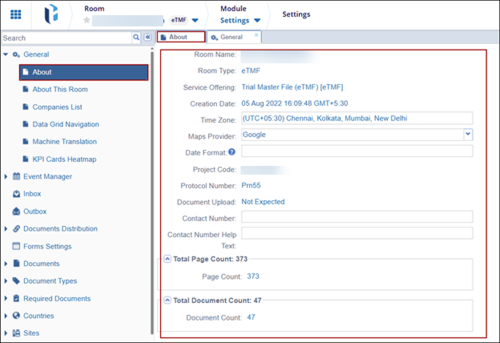 Note: Page and document counts for study start-up are displayed only when the Study Start-Up module is enabled for the room.
About This Room
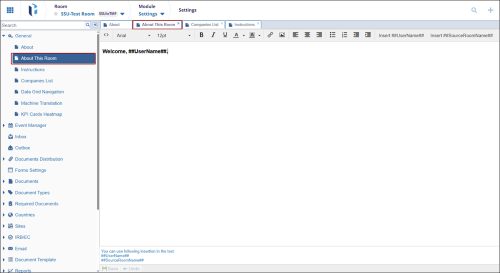
The About This Room settings page allows users to configure welcome message containing information about the specific room. The user can include placeholders such as ##UserName## and ##SourceRoomName## to dynamically display the user’s name and room name.
-
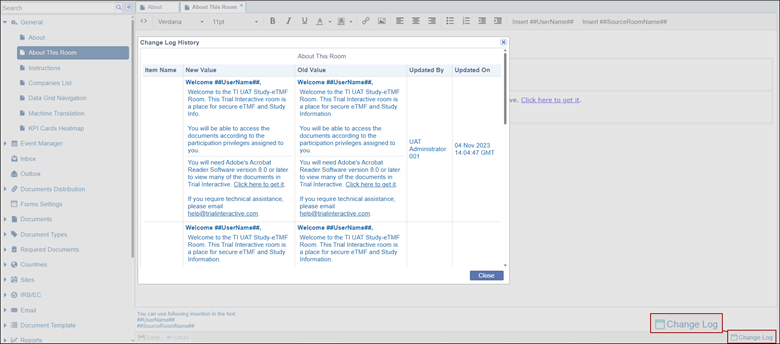
Item Name
-
New Value
-
Old Value
-
Updated By
-
Updated On (with the timestamp)
Instructions
- Select Instructions from the left-hand navigation pane.
- Enter the required text and click Save.

Companies List
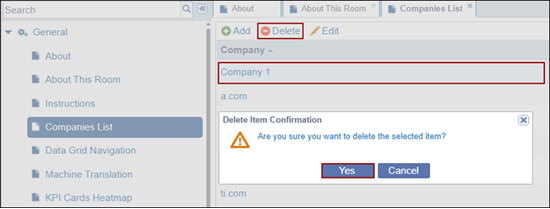
The Companies List page enables room administrators to add, edit, or delete companies. Companies configured on this page are available for selection when associating a company with a user during the user creation process.
- On the Companies List page, click +Add and enter the company name.

- To edit a company name, double-click the company name or select the company and click
Edit, then make the required changes.
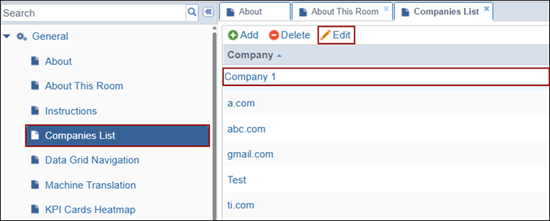
- To delete the record, select the company and click Delete.
- Click Yes on the confirmation pop-up.
- Companies that currently have users assigned to them cannot be deleted.
- To delete a company, access the Users Management module and reassign any users to
another company before proceeding.

Data Grid Navigation
- Minimum number of records per page in the data grid
- Minimum number of documents to show in the unread documents grid
- Number of days to show last registered users
- Start-Up dashboard recent Sites number
- Start-Up dashboard recent communication log items number
- Start-Up dashboard recent tasks number

Machine Translation
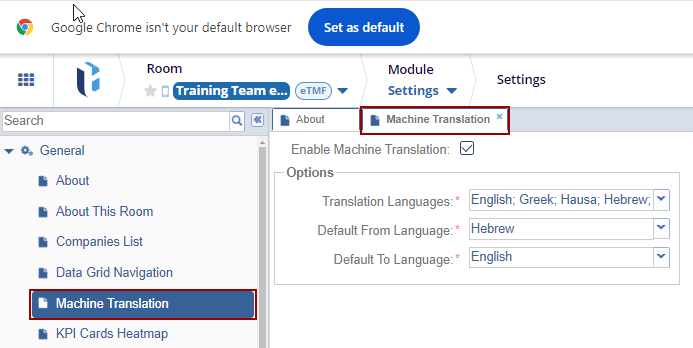
The ‘Machine Translation’ menu provides users with control over the Machine Translation feature, offering three options to customize its behavior according to their specific needs.
- On the Machine Translations page, check the Enable Machine Translation checkbox.
- Access the dropdown for the below settings and choose the required languages.
- Translation Languages: This menu allows users to switch languages based on their preferences or specific requirements.
- Default From Language: This menu allows users to set the starting point for the translation process.
-
Default To Language: This menu allows users to define the target language for translations.
KPI Cards Heatmap
The KPI Cards Heatmap in the Trial Interactive settings provides a quick visual overview of key performance indicators (in numbers) across various categories, such as:
- Total Document Count
- Countries
- Pending Sites
- Active Sites
- Collected Documents
- Require Coding
- Final Documents
- Expired Documents
- Open Queries
- Periodic Review Documents
- eSignature Requests
The heatmap uses color-coded thresholds (Green, Yellow, Red) to indicate performance levels or urgency.
- Double-click on the heatmap cells and specify the minimum and maximum data range for each category.
- Click on the ‘x’ icon to remove a specific category and click Save.
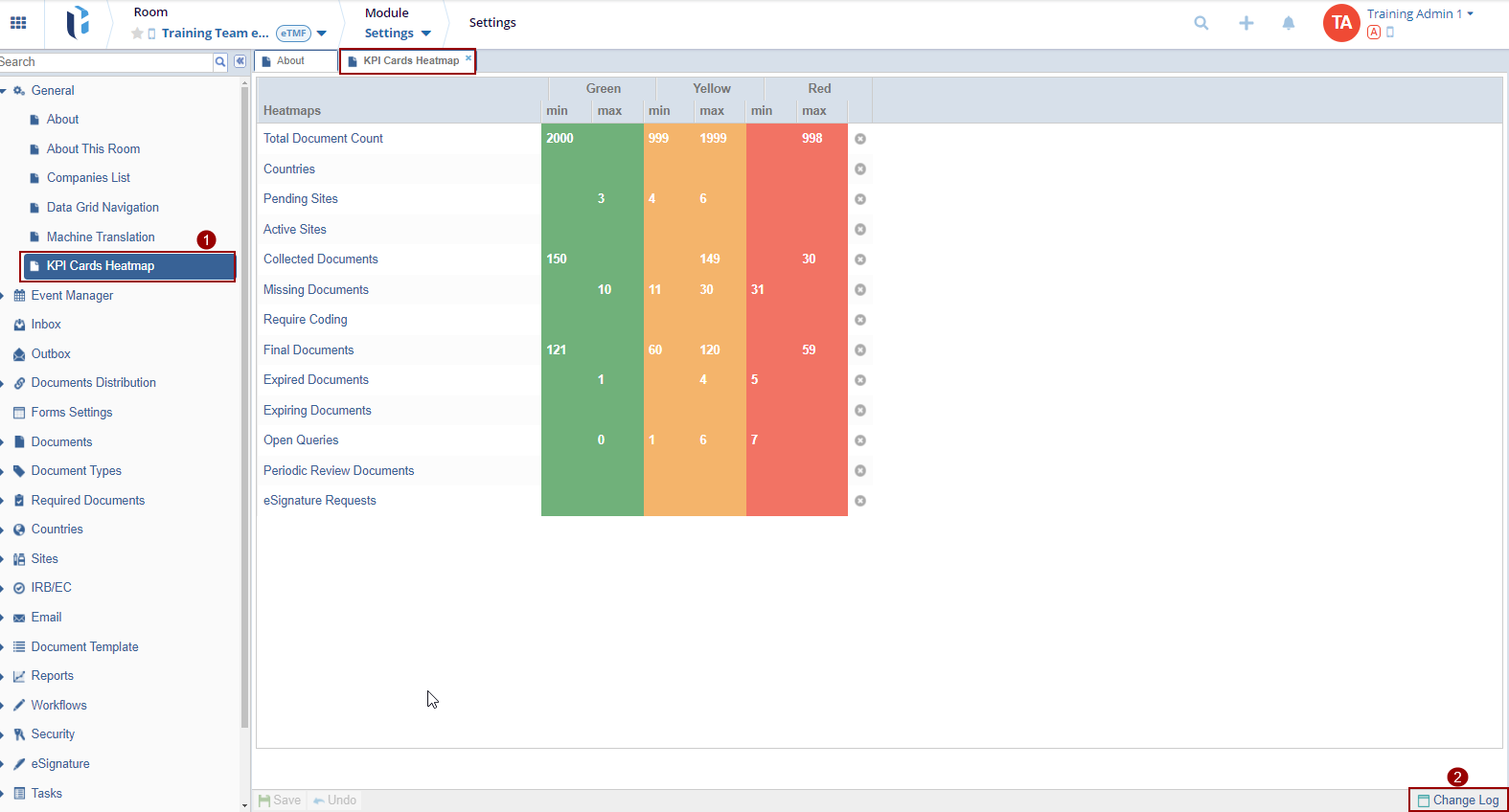
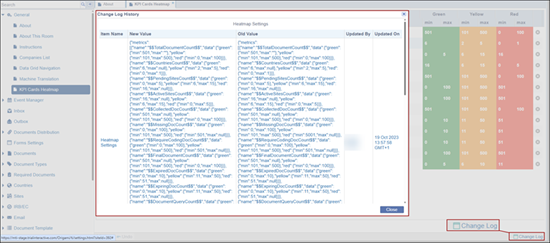
- Click the Change Log button, located at the bottom right of the screen, that displays
changes made to the KPI Cards Heatmap in the following columns.
- Item Name
- New Value
- Old Value
- Updated By
- Updated On (with the timestamp)

 Linkedin
 X
X

